
AI assistants are changing how customers and professionals discover products and services, from finding a gelato shop to selecting a supplier. For the Foodservice industry, the new challenge is making products, services and expertise easy to identify.
A customer is looking for a pastry shop offering gluten-free breakfast options. A tourist wants to find an artisanal gelato shop near their hotel. A restaurant owner needs to identify a supplier of flour suitable for contemporary pizza.
Until recently, these searches would have involved browsing multiple websites, reviews, digital maps and commercial catalogues. Today, part of this process can be handled by an AI-powered assistant.
The change is not just about search speed. AI can also influence the selection of alternatives by interpreting users' needs and suggesting which businesses or products to consider.
For restaurants, gelato shops, pastry shops, bakery cafés and professional suppliers, this raises a new commercial question: how can they ensure their offerings are discovered, understood and accurately recommended by AI assistants?
From Online Search to Personalised Recommendations
Traditional online searches often begin with a keyword, such as "gelato shop Milan", "brunch near me" or "professional chocolate supplier".
Searching through an AI assistant can be much more detailed.
A user might ask: "Where can I have breakfast on Sunday with artisanal pastries, lactose-free options and the possibility to book a table?"
In this case, the system must do more than identify businesses within a particular category. It needs to interpret several criteria simultaneously: location, product offering, dietary requirements, opening hours and available services.
The difference is significant. Consumers are not necessarily searching for a name they already know, but for a solution that meets their needs.
This shift is part of a broader trend. According to Curious Plot's Consumer Curiosity Report 2026, as reported by Baking Business, 74% of surveyed food early adopters use AI to support food-related decisions, compared with 55% the previous year.
The research focuses on a US sample of consumers who are particularly interested in new food trends. It therefore does not represent the behaviour of the general population or restaurant customers specifically.
Nevertheless, it signals a shift in how consumers discover products and services: for some, AI is becoming one of the tools they use to explore new options.
Gelato Shops, Pastry Shops and Bakery Cafés: Making Your Offering Understandable to AI
For a Foodservice business, having an online presence does not necessarily mean that an AI assistant can easily interpret its offering.
Consider a gelato shop offering fruit sorbets made without animal-derived ingredients, seasonal flavours and a selection of dairy-free products.
If this information is only available through display counter photographs, temporary social media posts or outdated menus, an automated system may struggle to identify it correctly.
The same situation can arise for a pastry shop specialising in individual desserts, a bakery café offering savoury options or a venue organising tastings by reservation.
The solution is not simply to produce more content, but to clearly communicate what makes the business distinctive.
A gelato shop, for example, can describe its product categories, ingredients and options for specific dietary requirements on its website. A pastry shop can clearly indicate whether it offers breakfast, plated desserts, takeaway products or event catering services.
For a bakery café, relevant information may include brunch hours, reservation availability, an up-to-date menu and product characteristics.
None of this information is new to consumers. What is new is that AI systems can also use it to formulate recommendations.
From Reviews to Digital Menus: What Information Matters?
Whether a business can be discovered through AI depends on several factors, which vary according to the platform and the type of query.
There is no universal formula that guarantees a restaurant or pastry shop will appear in AI-generated recommendations.
However, certain digital practices can help search systems interpret business information correctly.
In its documentation on structured data for local businesses, Google identifies properties such as address, opening hours, cuisine type, contact details, price range and menu links.
This information can be organised using LocalBusiness markup, with the Restaurant subtype where appropriate.
Using structured data does not guarantee inclusion in AI recommendations, but it helps make information easier for the systems that use it to interpret.
For businesses, this means ensuring consistency across their websites, business listings, digital menus and reservation platforms.
Outdated opening hours, a difficult-to-access menu or an ambiguously described service can create incorrect expectations.
The commercial risk is not simply being overlooked. It is also being recommended for services or features the venue no longer offers, potentially compromising the guest experience before the customer even arrives.
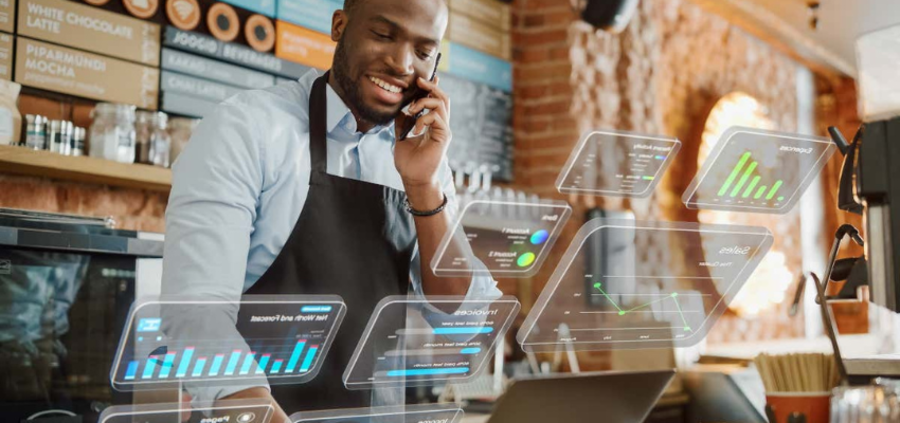
The Menu Becomes a Tool for Commercial Discovery
In Foodservice, the menu is one of the most important touchpoints between products and consumers.
Traditionally, its primary role has been to help customers choose after entering a venue or opening an ordering platform.
With AI-mediated search, the menu can play a role at an earlier stage: helping determine whether a business is relevant to a particular request.
Consider someone searching for "a breakfast with high-fibre products" or "a dessert made without animal-derived ingredients".
An assistant may try to identify businesses that meet these requirements using publicly available information.
For this reason, a generic description such as "wide selection of artisanal products" provides less useful detail than one that clearly explains the categories available on the menu.
Naturally, accuracy is essential when dealing with allergens and dietary requirements. An AI assistant may misinterpret information or rely on outdated data, so it should never be treated as a guarantee of food safety.
Businesses must therefore maintain reliable documentation, communicate ingredients accurately and provide direct channels for verifying specific requirements.
The commercial opportunity comes from clarity, not from accumulating labels or nutritional claims.
Beyond Consumers: AI Could Also Change Supplier Selection
The potential impact of AI on commercial discovery is not limited to end consumers.
Across the professional Foodservice supply chain, this shift could also affect how businesses search for ingredients, semi-finished products, technologies and equipment.
A gelato maker looking to introduce a new product range could use an AI assistant to explore different bases, stabilisers or technological solutions.
A pastry chef might search for chocolate couverture with specific fluidity characteristics. A baker might want to compare mixers based on production volumes and the types of dough they process.
In these cases, the search does not necessarily begin with a manufacturer's name. It begins with a technical problem.
An assistant can help create an initial shortlist of alternatives, but professional purchasing decisions still require further checks on technical specifications, performance, certifications, availability and commercial terms.
It is important to distinguish existing evidence from future possibilities: research on AI shopping primarily focuses on consumer behaviour and e-commerce. It does not yet demonstrate that most foodservice professionals select their suppliers through AI assistants.
However, it does highlight the growing importance of structured information in product discovery systems.
For ingredient and equipment manufacturers, this creates a tangible opportunity: making their technical expertise discoverable through searches framed around specific problems to solve.
The Case of AI Shopping: Why Data Quality Becomes a Commercial Asset
AI shopping platforms offer an indication of how product selection could evolve.
OpenAI explains that the shopping results displayed by ChatGPT can use structured metadata, product information and content from merchants and other sources.
Relevant characteristics may include descriptions, prices, availability and relevance to the user's request.
The system can therefore present a selection of products without necessarily displaying every available alternative.
This introduces a new competitive factor: a product could be excluded from the selection not because it is technically less suitable, but because the available information does not describe its characteristics accurately enough.
To improve the quality of commercial data, OpenAI's Agentic Commerce Protocol also provides a way to share structured catalogues containing information such as product identifiers, descriptions, prices, availability and delivery options.
These infrastructures have been developed for digital commerce. They do not constitute a universal automated purchasing system for foodservice ingredients and equipment.
Nevertheless, the direction is relevant for professional suppliers: technical product specifications could also become a resource for AI-mediated commercial discovery.
From Product Specifications to the Problem a Product Solves
For an ingredient or equipment manufacturer, describing a product solely through its commercial code and a brief overview may no longer be sufficient.
Consider a dark chocolate couverture intended for praline making.
A traditional catalogue might list its cocoa percentage, format and commercial name. A professional using an AI assistant, however, might search for a solution to create thin chocolate shells, work with complex moulds or meet specific production requirements.
To provide an accurate answer, the system would need access to information about fluidity, recommended applications, processing conditions and formulation characteristics.
The same principle can be applied to other SIGEP sectors.
In gelato, relevant information could include the application characteristics of a base, usage conditions and compatibility with specific recipes.
In bakery, relevant parameters might include mixing capacity, hydration levels, processing times and intended applications.
For equipment, a professional comparison could require information on productivity, energy consumption, dimensions, maintenance and after-sales support.
These are not an official list of factors used by all AI assistants. They are examples of information that could make product selection more relevant and verifiable.
The commercial implication is significant: a product's visibility depends not only on how extensively it is promoted, but also on how clearly it is explained to the professionals who need to use it.
How to Prepare Without Chasing Every New Platform
For Foodservice operators, the growing role of AI in product discovery does not necessarily require immediate investment in new technologies.
The first step can be to assess the quality of the information already available.
A gelato shop can check whether its website displays accurate opening hours and clearly describes its product categories. A pastry shop can make its reservation services and information about its specialities easily accessible. A bakery café can verify that its online menu matches its actual offering.
For a B2B supplier, the priority may be updating product specifications and technical documentation, ensuring consistency across the official website, catalogues and distributors.
Another useful step is to periodically test searches phrased as potential customers would formulate them: not simply by entering the company name, but by describing needs, constraints and applications.
For example, asking which gelato shops offer a particular type of product or which features to look for in equipment designed for a specific process can help identify missing or unclear information.
These tests are useful for exploratory purposes, but they do not constitute a scientific measurement of visibility. Responses can vary over time, between different systems and depending on the user's context.
The New Foodservice Competition Begins Before the Visit
Artificial intelligence cannot replace the quality of gelato, the identity of a pastry shop or the expertise of a professional supplier.
However, it can influence the moment when potential customers decide which alternatives to consider.
For a venue, this means that menus, services and digital information can contribute to the initial selection, even before consumers visit its website or enter the premises.
For supply chain manufacturers, it means that technical documentation and application-focused product descriptions could play a more important role in the early stages of commercial research.
This shift is not yet uniform, and there are no guarantees of visibility in AI recommendations. However, a clear direction is emerging: the ability to accurately describe what a business offers is becoming part of its competitiveness.
For the foodservice industry, the strategic question will no longer be simply how to attract new customers online, but also how to make its offering recognisable and relevant when an AI assistant is responsible for creating the initial shortlist.
Sources and Further Reading
Baking Business — Cathy Siegner, AI Guides Early Food Adopters, 9 October 2026. Analysis of the findings from Curious Plot's Consumer Curiosity Report 2026, including data on AI adoption among food early adopters.
https://www.bakingbusiness.com/articles/67031-ai-guides-early-food-adopters
Google Search Central — Local Business Structured Data (LocalBusiness). Official documentation on describing businesses through structured information, including opening hours, addresses, cuisine types and menus.
https://developers.google.com/search/docs/appearance/structured-data/local-business
OpenAI Help Center — Shopping with ChatGPT Search. Documentation explaining how products are selected and displayed in shopping results, including the role of structured metadata and merchant information.
https://help.openai.com/en/articles/11128490-improved-shopping-results-from-chatgpt-search
OpenAI Developers — Agentic Commerce Protocol. Documentation on the infrastructure for sharing structured commercial data, including catalogues, availability and product information.
https://developers.openai.com/commerce
OpenAI Developers — Key Concepts: Agentic Commerce. Specifications covering product feeds and the information used in AI-assisted commerce systems.
https://developers.openai.com/commerce/guides/key-concepts
Schema.org — LocalBusiness. Specifications for representing businesses, locations and related information in a structured format.
PUBLICATION
20/10/2026
Other related news

The future of coffee: trends and innovations for industry operators

SIGEP WORLD brings artisan gelato to the world

05/05/2026
Golden milk: from Ayurvedic remedy to a $1.6 billion global beverage trend

How grocery stores are reshaping Foodservice

Why partnerships between established companies and startups are on the rise?

Tik Tok and the taste revolution: the viral food & beverage trends in 2025

From Starbucks Bear Cup to Labubu: 3 takeaways for foodservice operators

Fragrant Breakfast: the new quiet luxury of Foodservice

Angel Hair Chocolate: the viral sensation redefining chocolate indulgence

The future of Foodservice is hybrid: key insights from the SIGEP Vision Talk 2026

Fine pastry meets luxury: multisensory experiences, hospitality and high-end lifestyle

India food market trends: strategic opportunities for B2B foodservice

Maximizing ROI from Trade Shows: A Buyer’s Guide to Success

Menu Proteinization: How Protein, Fiber and Satiety Are Transforming Bakery, Gelato and Quick Service

New trends in pastry: innovation, exotic flavors, and sustainability

Reimagining ravioli the rise of hybrid dumplings and fusion flavors in bakery and pastry menus